
2026 F1
2026 Japanese GP FP2 Results – Piastri Leads Tight Field in Suzuka Practice

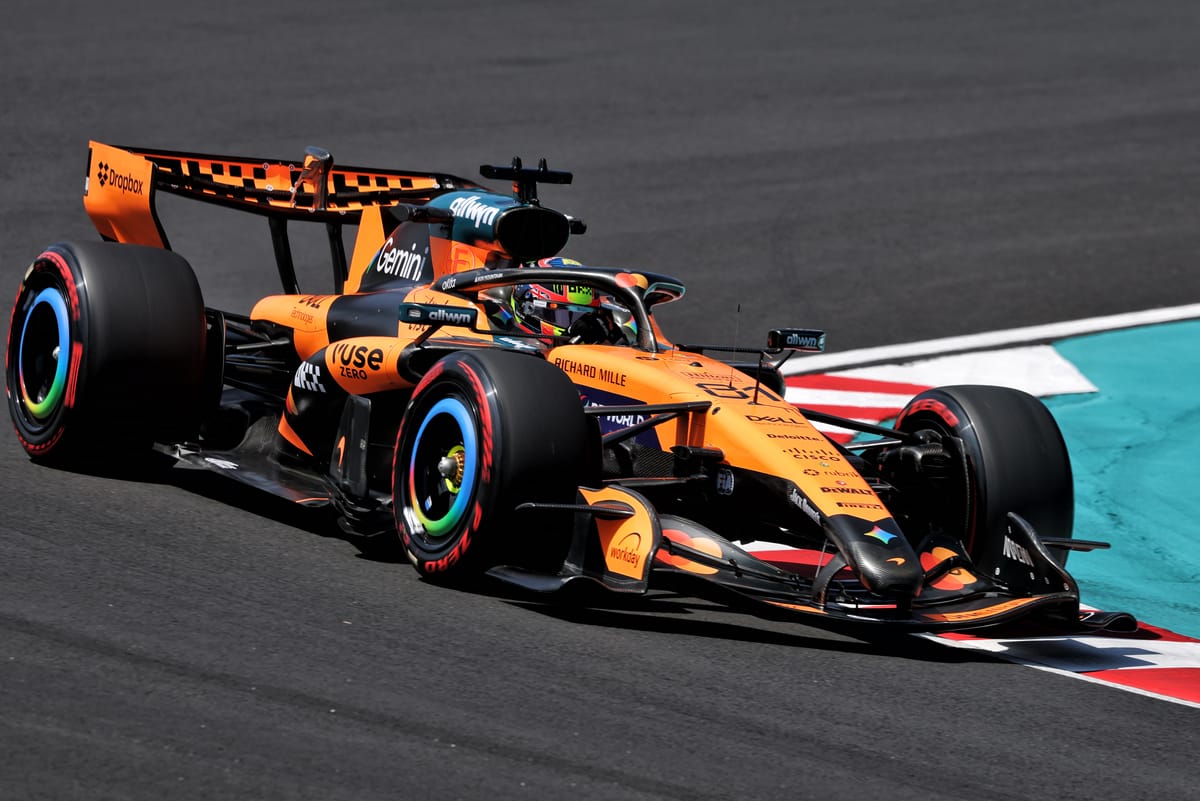
Piastri’s teammate Lando Norris also showed competitive speed, finishing inside the top four, confirming McLaren’s strong form at Suzuka.
Hot on their heels, Kimi Antonelli secured P2 for Mercedes, just +0.092s behind, while George Russell followed in P3, completing another solid session for the Silver Arrows.
Ferrari in the Mix, But Slightly Behind
Both Charles Leclerc and Lewis Hamilton placed within the top six for Ferrari, but were still over seven tenths off the pace, suggesting there’s work to be done ahead of qualifying.
Red Bull Struggles Continue?
It was a less dominant showing from Max Verstappen, who could only manage P10 for Red Bull Racing, over a second down on the leader. The team appears to be searching for balance on the challenging Suzuka circuit.
| Pos. | No. | Driver | Team | Time / Gap | Tyre | Laps |
|---|---|---|---|---|---|---|
| 1 | 81 | Oscar Piastri | McLaren | 1:30.133 | S | 29 |
| 2 | 12 | Kimi Antonelli | Mercedes | +0.092 | S | 28 |
| 3 | 63 | George Russell | Mercedes | +0.205 | S | 29 |
| 4 | 4 | Lando Norris | McLaren | +0.516 | S | 17 |
| 5 | 16 | Charles Leclerc | Ferrari | +0.713 | M | 28 |
| 6 | 44 | Lewis Hamilton | Ferrari | +0.847 | M | 27 |
| 7 | 27 | Nico Hulkenberg | Audi | +1.308 | S | 27 |
| 8 | 23 | Alexander Albon | Williams | +1.363 | S | 30 |
| 9 | 87 | Oliver Bearman | Haas | +1.365 | M | 28 |
| 10 | 1 | Max Verstappen | Red Bull | +1.376 | H | 29 |
| 11 | 31 | Esteban Ocon | Haas | +1.399 | M | 30 |
| 12 | 30 | Liam Lawson | Racing Bulls | +1.457 | M | 31 |
| 13 | 55 | Carlos Sainz | Williams | +1.475 | S | 30 |
| 14 | 10 | Pierre Gasly | Alpine | +1.601 | H | 29 |
| 15 | 6 | Isack Hadjar | Red Bull | +1.626 | H | 29 |
| 16 | 5 | Gabriel Bortoleto | Audi | +1.800 | S | 11 |
| 17 | 43 | Franco Colapinto | Alpine | +2.305 | M | 28 |
| 18 | 77 | Valtteri Bottas | Cadillac | +2.482 | M | 28 |
| 19 | 14 | Fernando Alonso | Aston Martin | +3.463 | S | 24 |
| 20 | 11 | Sergio Perez | Cadillac | +3.556 | H | 14 |
| 21 | 18 | Lance Stroll | Aston Martin | +3.818 | S | 21 |
| 22 | 41 | Arvid Lindblad | Racing Bulls | +4.000* | M | 1 |
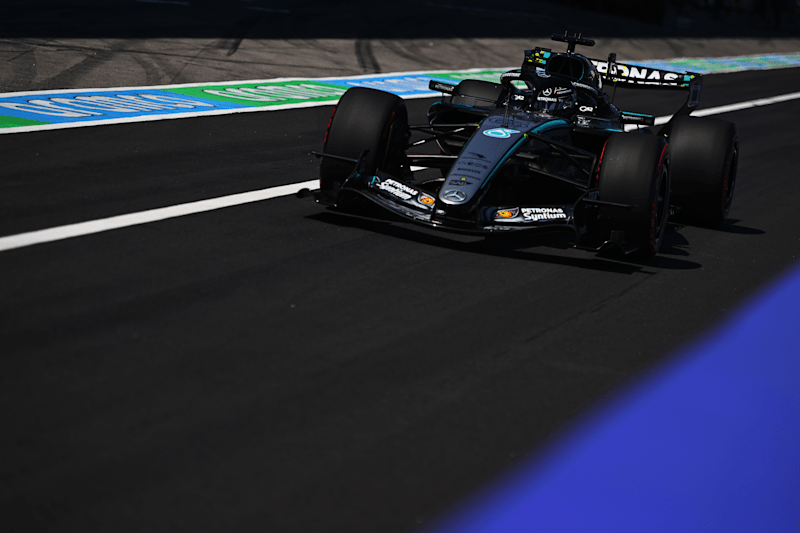
George Russell topped the timing sheets with an impressive lap, narrowly edging out his teammate Kimi Antonelli, who finished just +0.026s behind. This strong 1–2 finish highlights Mercedes’ promising form heading into the weekend.
Meanwhile, Lando Norris secured P3 for McLaren, followed closely by teammate Oscar Piastri in fourth place, reinforcing McLaren’s consistent pace.
Rounding out the top five was Charles Leclerc representing Ferrari, showing competitive speed but still a few tenths off the leaders.
| Pos. | No. | Driver | Team | Time / Gap | Laps |
|---|---|---|---|---|---|
| 1 | 63 | George Russell | Mercedes | 0.0709 | 27 |
| 2 | 12 | Kimi Antonelli | Mercedes | +0.026s | 26 |
| 3 | 1 | Lando Norris | McLaren | +0.132s | 20 |
| 4 | 81 | Oscar Piastri | McLaren | +0.199s | 23 |
| 5 | 16 | Charles Leclerc | Ferrari | +0.289s | 25 |
| 6 | 44 | Lewis Hamilton | Ferrari | +0.374s | 23 |
| 7 | 3 | Max Verstappen | Red Bull Racing | +0.791s | 27 |
| 8 | 30 | Liam Lawson | Racing Bulls | +0.863s | 27 |
| 9 | 31 | Esteban Ocon | Haas F1 Team | +0.935s | 23 |
| 10 | 41 | Arvid Lindblad | Racing Bulls | +0.999s | 29 |
| 11 | 5 | Gabriel Bortoleto | Audi | +1.093s | 27 |
| 12 | 27 | Nico Hulkenberg | Audi | +1.132s | 26 |
| 13 | 6 | Isack Hadjar | Red Bull Racing | +1.137s | 27 |
| 14 | 87 | Oliver Bearman | Haas F1 Team | +1.234s | 27 |
| 15 | 10 | Pierre Gasly | Alpine | +1.312s | 25 |
| 16 | 43 | Franco Colapinto | Alpine | +1.695s | 24 |
| 17 | 55 | Carlos Sainz | Williams | +1.717s | 26 |
| 18 | 23 | Alexander Albon | Williams | +2.031s | 22 |
| 19 | 11 | Sergio Perez | Cadillac | +2.555s | 18 |
| 20 | 77 | Valtteri Bottas | Cadillac | +2.824s | 24 |
| 21 | 18 | Lance Stroll | Aston Martin | +3.628s | 22 |
| 22 | 34 | Jak Crawford | Aston Martin | +4.696s | 11 |
A significant technical directive has landed ahead of qualifying for the 2026 Japanese Grand Prix, and it has the paddock at Suzuka buzzing.
In an official statement released on Friday, the FIA confirmed a “minor adjustment” to energy management parameters for this weekend’s qualifying session. The maximum permitted energy recharge has been cut from 9.0 MJ to 8.0 MJ —a reduction of roughly 11%.
The change, agreed unanimously by all Power Unit Manufacturers, is officially framed as a move to “maintain the intended balance between energy deployment and driver performance.” But let’s be honest: in the high-stakes world of F1, no technical change is ever truly neutral.
So, as the Suzuka paddock settles into its Friday rhythm, one question is dominating the conversation among tifosi and analysts alike: Is this good or bad for Ferrari?
The Technical Context
Under the sweeping 2026 regulations, Power Units have become hybrid-heavy beasts. Electrical energy is everything—especially in qualifying, where teams deploy maximum power for a single glory lap.
By trimming the recharge limit by 1.0 MJ, the FIA has effectively reduced the amount of hybrid energy available to drivers over a flying lap. The result? A subtle but meaningful shift in emphasis: internal combustion engine efficiency and chassis grip matter more now, while simply dumping maximum electrical deployment out of corners becomes less of a trump card.
And that shift could have major implications for the pecking order.
Ferrari: The Potential Loser
Let’s not dance around it. Early signs from the 2026 season suggest Ferrari has built something special with its electrical deployment. The SF-26 has looked formidable in qualifying trim, using every bit of that 9.0 MJ allowance to fire out of slow-speed corners—exactly the kind of sectors that define Suzuka’s tight esses and the infamous hairpin.
Why This Hurts Ferrari
If Ferrari’s one-lap advantage has been built on superior hybrid harvesting and deployment, capping the recharge limit is effectively capping their strongest weapon. By lowering the ceiling to 8.0 MJ, the FIA has narrowed the window where Ferrari’s electrical dominance could shine.
There’s also the historical context. Ferrari’s engine philosophy has often leaned on the equation that “more electrical power equals less fuel burn,” allowing for lighter car setups in qualifying. Now, with less energy in the pocket, engineers may need to scramble to recalibrate engine maps to avoid running out of charge before the finish line—a problem that has bitten Ferrari before when deployment strategies were too aggressive.
For a team chasing its first championship in nearly two decades, this is an unwelcome curveball.
Mercedes: The Silent Beneficiary
Now, flip the garage. Mercedes approached the 2026 regulations with a different philosophy: a focus on ICE efficiency and aerodynamic correlation. While their electrical motor is nothing to scoff at, the Brackley squad has always prioritized mechanical grip and tire warm-up over peak electrical deployment.
Why This Helps Mercedes
Reducing energy recharge rewards drivability. Mercedes’ Power Unit has long been the benchmark for seamless power delivery. When drivers have less electrical “boost” to mask oversteer or wheelspin, the driver who can manage the throttle with precision gains the upper hand.
Toto Wolff’s camp likely sees this adjustment as quiet validation of their “all-rounder” approach. Mercedes has consistently argued that qualifying should test driver skill and chassis balance—not devolve into a “push-to-pass” electrical arms race.
With the reduction to 8.0 MJ, Mercedes’ aerodynamic stability in high-speed corners—Suzuka’s 130R and Spoon curve, to name two—becomes proportionally more valuable. Ferrari may have the edge in acceleration zones, but the Silver Arrows look poised to claw back time where it matters most.
The Rivalry Dynamic
This technical tweak has thrown a wrench into the expected qualifying order.
If Ferrari struggles: Expect Charles Leclerc and Lewis Hamilton—yes, the seven-time champion now in red—to voice frustration over a lack of “pop” exiting the final chicane. If Ferrari was banking on the full 9.0 MJ to lock out the front row, they could find themselves shuffled to P3 or P4. On a circuit where overtaking is notoriously difficult, that’s a massive disadvantage.
If Ferrari adapts: There’s a counterargument. If Ferrari’s advantage lies in the base efficiency of the MGU-K rather than just the peak number, they may weather the storm. But the sudden nature of this change—agreed upon just before the weekend—favors the team with the most agile software and calibration operation. Historically, that’s been Mercedes.
The Bottom Line
On paper, this is bad for Ferrari, good for Mercedes.
The FIA’s language—”targeted refinement” to preserve qualifying as a “performance challenge”—feels like diplomatic code for slowing down the cars where they got too fast via electrical means. Since Ferrari appeared to hold the edge in that domain, they stand to lose the most.
For Ferrari to turn this negative into a neutral outcome, they’ll need the SF-26’s chassis—developed under the guidance of Loic Serra and Jerome d’Ambrosio—to be strong enough to compensate for the loss of their electrical artillery. If not, Mercedes (and perhaps a lurking McLaren) will be licking their lips as qualifying approaches at Suzuka.
One thing’s for sure: Saturday’s qualifying session just got a whole lot more interesting.
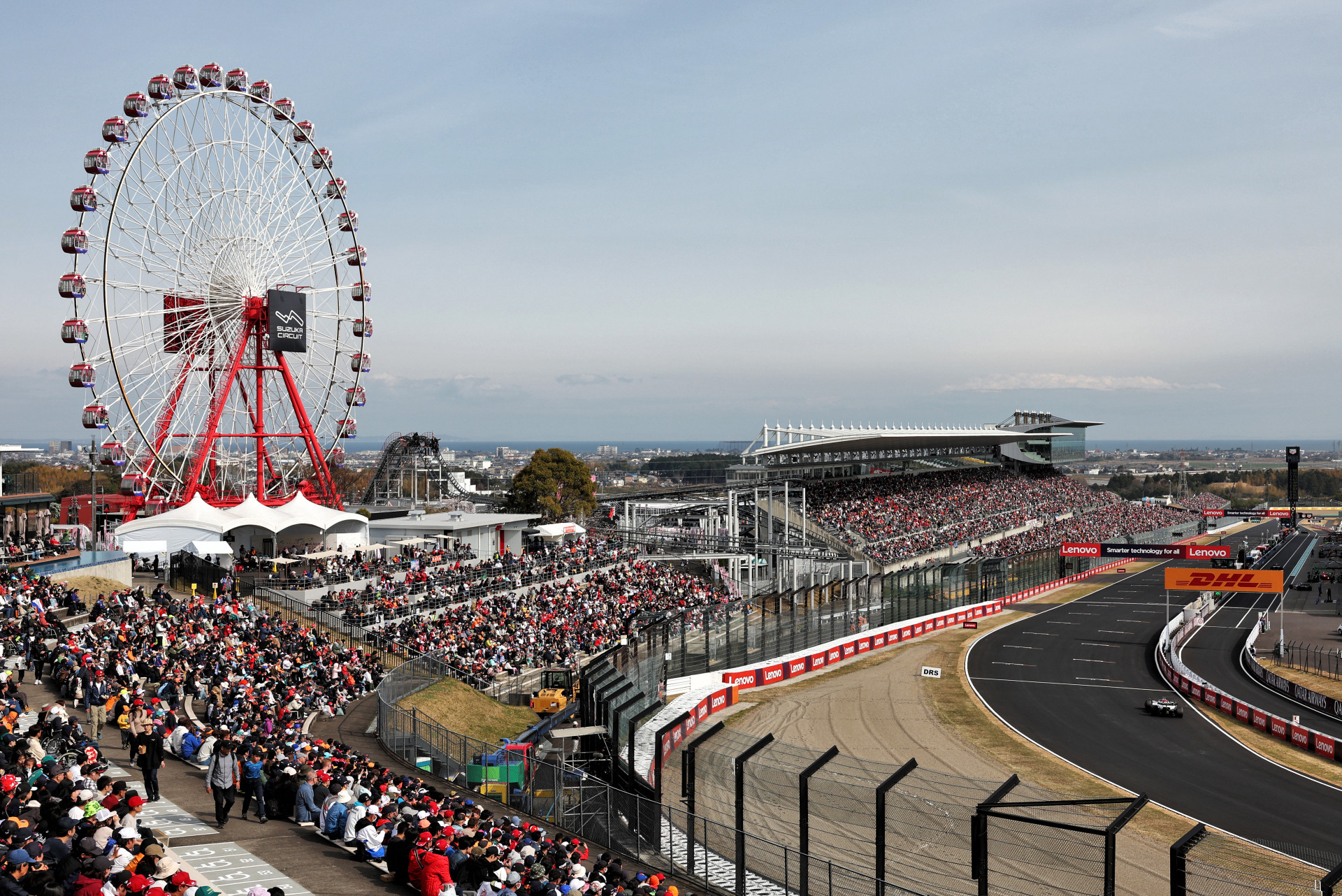
SUZUKA — The paddock chatter surrounding a potential Ferrari-orchestrated test at Monza is already fading, extinguished by a combination of rival opposition and a fresh regulatory intervention from the FIA aimed at Formula 1’s embattled 2026 power unit regulations.
The unexpected cancellation of the Gulf races in April carved out a rare gap in the calendar, fueling speculation that Ferrari could utilize the window for additional track running, potentially extending an invitation to other outfits to share the data. However, that prospect now appears increasingly remote.
When asked about the forthcoming hiatus, Ferrari team principal Frederic Vasseur acknowledged the importance of the downtime, albeit without committing to a formal test. “After this race, we also have a month in Maranello, which will be important to analyse the data collected from the first three races and continue to develop the car in the right direction,” Vasseur said.
While Monza was floated as a logical venue—given the circuit’s proximity to the Scuderia’s headquarters—the idea has failed to gain traction. Sources indicate that Mercedes, currently wielding a dominant position in the pecking order, along with Aston Martin, Williams, and McLaren, are reluctant to green-light additional running that could upset the competitive equilibrium.
FIA Intervenes with Qualifying Tweaks
As the debate over testing faded, attention shifted to the regulatory fixes required to salvage the spectacle of the new power unit era. Following extensive dialogue with teams and manufacturers, the FIA confirmed on Thursday a targeted adjustment to energy management protocols, specifically for qualifying at Suzuka.
In a move designed to curb excessive harvesting and mitigate the lift-and-coast phenomenon that has plagued the season’s opening rounds, the maximum permitted energy recharge has been reduced from 9 megajoules to 8. The change aims to allow drivers to push flat-out during qualifying laps without being artificially hindered by energy constraints.
“This adjustment reflects feedback from drivers and teams,” the FIA stated, “who have emphasised the importance of maintaining qualifying as a performance challenge.”
The governing body added that further discussions are already on the horizon, signaling that this is merely the first step in an ongoing effort to refine the sport’s controversial new technical regulations.
Verstappen’s Blunt Assessment Echoes Through the Paddock
Among the most vocal critics of the current trajectory has been Max Verstappen. While the quadruple world champion remained unfazed by the latest regulatory tweaks, he continued to expand his extracurricular racing portfolio, having spent time earlier in the week testing a Red Bull-liveried Super GT Nissan at Fuji.
Aston Martin simulator driver Dani Juncadella, who shares a GT3 lineup with Verstappen on the Nordschleife, offered insight into the Dutchman’s unwavering stance on F1’s current direction.
“He’s been very blunt in his statements,” Juncadella told Diario Sport. “Since preseason, he’s been telling us that things were looking very bad, and he was absolutely right.”
Juncadella warned that the current regulatory framework risks reducing drivers to mere system managers rather than pure competitors.
“There were moments where overtaking happened in places where it wasn’t usually possible,” he explained. “But if you scratch the surface, it’s because the engine is clipping.
“They overtake, but not because of driver skill. Now they’re acting more like managers than drivers.”

Full Calendar: 2025 F1 Season Features a Record 24-Races

Race Results – F1 2025 Chinese Grand Prix

Chinese Grand Prix – 2025 F1 Drivers’ and Teams’ Standings

Reigning Champions McLaren revealed 2025 F1 Car – MCL39

Qualifying Results – 2025 F1 Australian Grand Prix

2026 Japanese GP FP2 Results – Piastri Leads Tight Field in Suzuka Practice

2026 Japanese GP FP1 Results – Mercedes Leads the Way

Ferrari or Mercedes: Who Wins from FIA’s Energy Cut?

FIA moves to fix F1 2026 rules as rivals block Ferrari test

Mercedes alters controversial Front Wing at Suzuka after Ferrari scrutiny—But not for the reason you think
-
 2025 F11 year ago
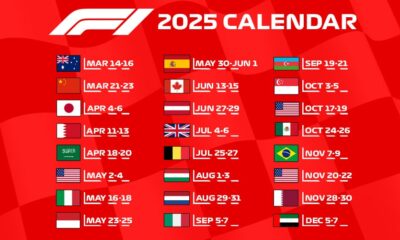
Full Calendar: 2025 F1 Season Features a Record 24-Races
-
 2025 F11 year ago
Race Results – F1 2025 Chinese Grand Prix
-
 2025 F11 year ago
Chinese Grand Prix – 2025 F1 Drivers’ and Teams’ Standings
-
 2025 F11 year ago
Reigning Champions McLaren revealed 2025 F1 Car – MCL39
-
 2025 F11 year ago
Qualifying Results – 2025 F1 Australian Grand Prix
-
 2025 F11 year ago
2025 F1 Testing Results – Day 1 – First Half
-
 2025 F11 year ago
Photos: Ferrari officially launched its 2025 F1 car SF-25
-
 2025 F11 year ago
2025 F1 Testing Schedule – Confirmed all three-day driver line-ups